
Data analytics can sometimes feel like an endless arms race of certifications. Every platform, cloud provider, and open-source library wants you to stack badges on your LinkedIn profile like military medals. Among these, the alteryx certification suite has earned a massive reputation. Alteryx is the undisputed heavy lifter of enterprise low-code/no-code data preparation and automated ETL (Extract, Transform, Load). But with a shifting tech landscape, the rise of AI-native analytics, and ongoing changes to corporate budgets, you have to ask yourself a hard question before diving into the study guides:
Is an Alteryx certification actually worth your time and effort?
Whether you’re a business analyst trying to climb the corporate ladder, a data scientist looking to speed up your data blending, or a student eyeing a job at a Big Four consulting firm, let’s break down the honest pros and cons of getting certified.
The Alteryx Certification Landscape
Alteryx cleaned up its certification ecosystem by retiring cluttered micro-credentials and focusing on core proficiencies. If you are looking to get certified, these are the primary paths you will encounter:
- Alteryx Essentials Certificate: The beginner track. It establishes a baseline understanding of foundational analytics concepts and the general layout of Alteryx tools.
- Designer Desktop – Core Certification: The real starting line for professionals. This exam tests your practical ability to clean, blend, map, and transform datasets using core Alteryx Designer tools.
- Designer Desktop – Advanced Certification: A deeper dive for experienced users. This covers sophisticated workflows, complex macros, spatial analytics, and predictive tools.
- Expert & Server tracks: Aimed at enterprise architects and advanced developers managing massive deployment environments.
To help you visualize the baseline options, here is how the primary entry-level credentials stack up:
| Certification Level | Target Audience | Key Skills Covered | Cost |
| Alteryx Essentials | Beginners & Students | Foundational data concepts, introductory tool layout | Free |
| Designer Core | Junior Analysts & Daily Users | Data blending, joining, basic transformations, parsing | Free |
| Designer Advanced | Senior Analysts & Consultants | Macros, apps, spatial analysis, predictive modeling | Free |
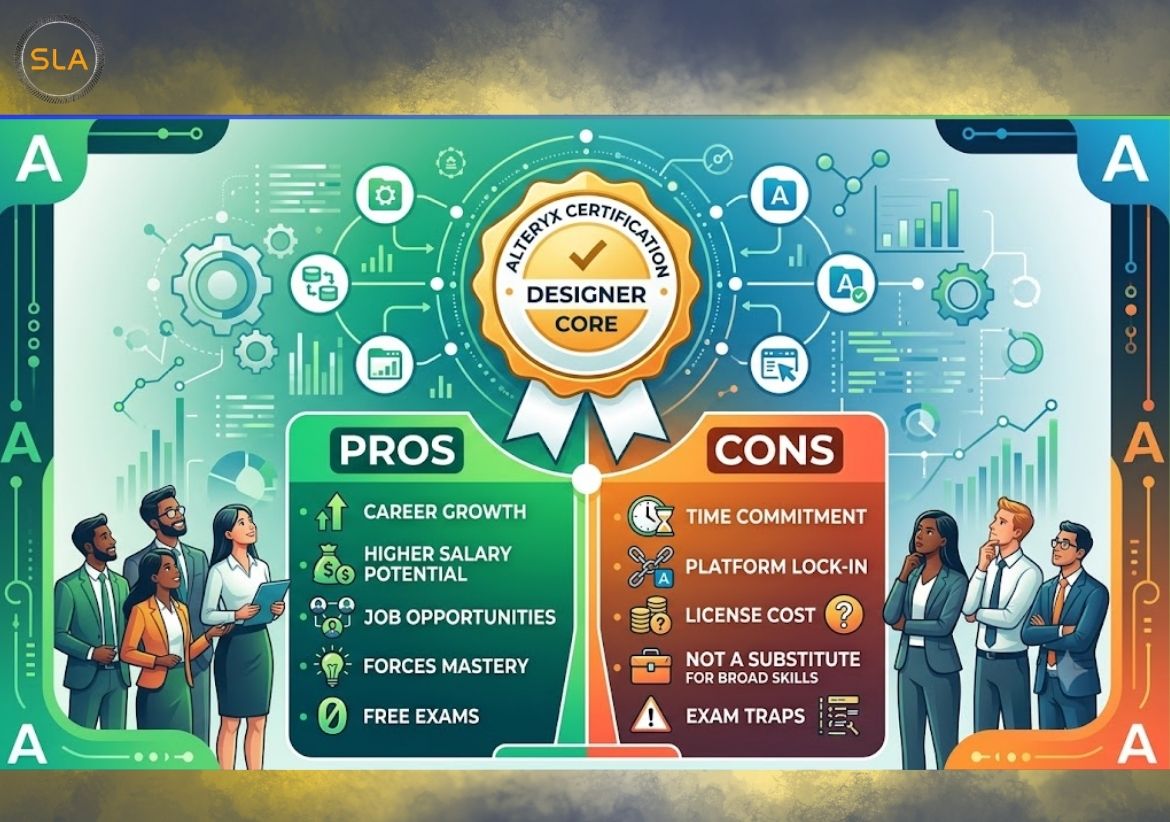
The Pros: Why an Alteryx Certification Is Worth It
Let’s start with the good news. There are highly compelling reasons why thousands of data professionals pursue these credentials every year.
1. The Cost-to-Value Ratio is Infinite (Literally)
Unlike many industry certifications that demand hundreds of dollars per attempt (looking at you, Salesforce and AWS), Alteryx makes its Essentials, Core, and Advanced exams completely free. You can study using their free Academy resources, take the online exam from the comfort of your couch, and pay absolutely nothing. Financially speaking, the return on investment is infinite because your initial capital outlay is zero.
2. High Demand in Corporate and Consulting Hubs
Alteryx isn’t typically used by tiny bootstrap startups; it is a premium enterprise tool. It is deeply embedded in Fortune 500 companies, major financial institutions, and global consulting firms (like Deloitte, PwC, EY, and KPMG). These organizations handle massive, messy legacy datasets and value employees who can build auditable, automated data pipelines without needing a computer science degree. Having an alteryx certification on your resume acts as a major green flag for corporate recruiters scanning for specific enterprise skills.
3. It Forces True Tool Mastery
Many people use Alteryx by relying on the exact same five or six tools every single day—usually just Select, Filter, Join, and Formula. Prepping for the Core or Advanced exams forces you out of your comfort zone. You’ll learn how to properly parse data with Regular Expressions (Regex), optimize workflow execution speeds, utilize advanced spatial tools, and build dynamic macros. The process of studying fundamentally makes you a faster, more creative problem solver.
4. It’s a Highly Visible Portfolio Alternative
Unlike Python or SQL, where you can easily share a GitHub repository to prove your skills, sharing complex Alteryx workflows publicly can be difficult due to proprietary data and licensing. A certification acts as a standardized, verified proof of competence that a hiring manager can instantly trust without needing to audit a visual workflow bundle.
The Freelancer’s Perspective: Many independent data consultants note that while a certification rarely wins a project on its own, it frequently acts as the baseline filter. Clients often use certifications to quickly shortlist contractors for high-value workflow migration or optimization projects.
The Cons: The Honest Caveats
No credential is a magic bullet. To make an informed decision, you need to understand the limitations and challenges associated with the ecosystem.
1. Severe Platform Lock-In
Alteryx is highly proprietary and notoriously expensive. A single designer license can cost thousands of dollars per user annually. Because of this steep price tag, if you transition to a company that doesn’t use Alteryx, your certification loses its immediate, hands-on utility. Unlike SQL or Python skills—which are universally transferable across any tech stack in the world—Alteryx skills are bound strictly to organizations willing to pay the licensing fee.
2. The Core Exam is a Brutal Time Crunch
Do not mistake “free to take” for “easy to pass.” The Alteryx Designer Core exam is a notoriously stressful experience. It requires you to answer 80 questions in a strict 2-hour window. This isn’t just a simple multiple-choice vocabulary quiz; you are required to open the software, process sample datasets on the fly, and figure out which tool configuration yields a highly specific output.
Many applicants fail on their first attempt simply because they run out of time. The question formats are intentionally tricky, often asking you to identify obscure configuration settings or select all options that apply from a complex list.
3. It Is Not a Substitute for Foundational Data Literacy
A certification proves you know how to operate a specific software interface, but it doesn’t automatically mean you understand data theory. It won’t teach you why a specific data model structure is flawed, how to handle complex relational database architecture, or the statistical realities behind a predictive model. If you rely solely on Alteryx without understanding foundational SQL, data normalization, or basic statistics, you risk becoming a tool operator rather than a true data strategist.
The Verdict: Should You Do It?
When weighing the pros and cons, deciding if an alteryx certification is worth it boils down to your current career trajectory and your immediate professional environment.
- You SHOULD get certified if:
- You want to work in enterprise consulting: If your goal is to land a job at a major consulting firm or a Fortune 500 analytics division, this credential will actively make your resume stand out in automated applicant tracking systems.
- Your current employer uses Alteryx: If the licenses are already paid for, getting certified is an obvious win. It positions you as an internal subject matter expert, opens doors for promotions, and lets you build automated workflows that save you hours of manual labor.
- You have the time to spare: Because the exam costs nothing but your time, it’s an incredibly low-risk way to add a technical credential to your professional profile.
- You SHOULD NOT get certified if:
- You don’t have access to the software: While the training material is free, you ultimately need access to Alteryx Designer to practice for the practical application questions on the exam. If you don’t have an enterprise license or a student trial, passing is incredibly difficult.
- You want to be a pure Data Engineer or Software Developer: If your focus is building cloud-native infrastructure, managing data warehouses, or writing production-level code, your time is vastly better spent mastering SQL, Python, dbt, or cloud platform architectures (AWS, Azure, Snowflake).
Ultimately, an Alteryx certification is an excellent, cost-effective career accelerator—provided you view it as a powerful specialized tool in your broader data toolkit, rather than your entire professional identity.