

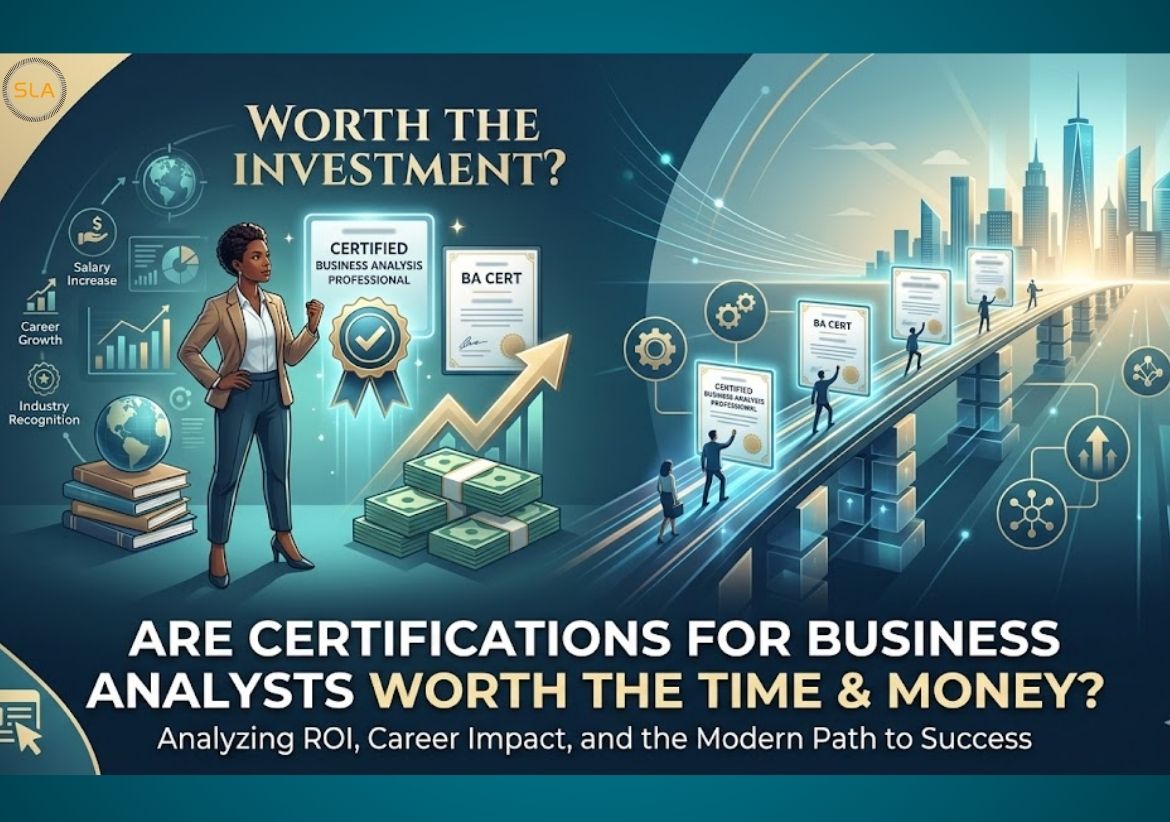
The landscape of business analysis has shifted dramatically. Gone are the days when a Business Analyst (BA) was merely a “requirement collector”—someone who sat in meetings, took notes, and spent hours manually drafting 50-page Business Requirement Documents (BRDs). Today, organizations are embedding artificial intelligence across every internal system, demanding measurable outcome-driven strategic alignment and decision intelligence. With generative AI tools capable of drafting user stories and generating process flows in seconds, the modern BA must step up as a strategic decision partner. This brings us to a critical, high-stakes question for anyone navigating this career path: Are certifications for business analysts worth the time and money?
If you are trying to break into the industry, secure a promotion, or pivot your skills to stay competitive, you are likely staring at a mountain of credential options. Let’s break down the true costs, real-world returns, and hidden nuances of investing in professional credentials.
The Landscape: Understanding Your Options
Before evaluating the financial and time commitments, it helps to understand exactly what the market offers. The credentials available generally fall into three major buckets: traditional business analysis frameworks, tool-specific validations, and data-driven specializations.
1. Traditional BA Framework Certifications
These are the industry standards governed by major international bodies like the International Institute of Business Analysis (IIBA) and the Project Management Institute (PMI). A foundational business analyst certification from these institutions focuses heavily on theoretical frameworks, standardized terminologies, and systemic methodologies.
- ECBA (Entry Certificate in Business Analysis): Designed for freshers and career changers. It proves you understand the core vocabulary and concepts of the Business Analysis Body of Knowledge (BABOK).
- CCBA & CBAP (Certified Business Analysis Professional): Aimed at mid- to senior-level practitioners. The CBAP is widely regarded as the gold standard for traditional corporate BA roles, requiring thousands of hours of documented on-the-job experience.
- PMI-PBA (Professional in Business Analysis): Focuses heavily on how business analysis intersects with project management frameworks.
2. The Shift Toward Data Fluency
As organizations move from descriptive reporting to forward-looking predictive analysis, the lines between business analysts and data professionals are blurring. Consequently, many modern BAs are expanding their horizons beyond traditional frameworks.
Pursuing a data analytics certification (such as the Google Data Analytics Professional Certificate or Microsoft’s PL-300 Power BI Data Analyst) has become highly popular. These credentials teach the practical mechanics of querying data with SQL, building interactive dashboards, and turning raw data into compelling narratives that leadership can actually trust.
For tech-heavy BAs or those working directly alongside machine learning engineers, a data science certification represents the deep technical tier. This involves learning foundational Python or R programming, data engineering pipelines, and the basics of predictive modeling.
The ROI Calculation: Counting the True Cost
To determine if certifications for business analysts are genuinely worth your resources, you must look at a realistic financial equation. The investment is never just the price of the exam ticket.
Net ROI Equation:
{Net ROI} = (Annual Salary Premium X Expected Years in Role) - (Exam Fees + Prep Materials + Opportunity Cost of Study Time)
Let’s look at a side-by-side comparison of what these different educational tracks demand from you in terms of real-world commitments:
| Certification Type | Average Exam & Prep Cost | Time Commitment | Core Focus Area |
| Traditional BA (e.g., IIBA ECBA / CBAP) | $350 – $1,200 | 100 – 250 Hours | BABOK frameworks, requirements life cycle, stakeholder management. |
| Data Analytics (e.g., Power BI, Google) | $49/mo – $500 | 80 – 150 Hours | SQL queries, dashboarding (Tableau/Power BI), data cleaning. |
| Data Science (e.g., IBM, Cloud Providers) | $300 – $1,000+ | 150 – 300 Hours | Python/R, statistical analysis, basic machine learning models. |
The “Opportunity Cost” Factor
If you earn $40 an hour in your current role and spend 200 hours studying for a premier certification like the CBAP, you have effectively invested $8,000 of your unbilled time alongside the formal $500 exam fee. For a credential to offer a positive ROI, it needs to either fast-track you into a job you otherwise wouldn’t get, or provide a noticeable lift to your baseline compensation.
When Are Certifications Totally Worth It?
Professional badges are not universally good or bad. Their value is highly contextual, depending on your current career stage and industry.
1. You Are a Career Changer or Entry-Level Candidate
If your resume doesn’t show a formal background in tech or business architecture, an entry-level credential provides an essential employer demand signal. It tells recruiters that you speak the corporate language, understand the Software Development Life Cycle (SDLC), and possess the discipline to pass a standardized exam. It gives an applicant tracking system (ATS) a reason to push your resume into the “yes” pile.
2. You Work in Highly Regulated, Enterprise Environments
In traditional, heavy industries—such as banking, financial services, insurance (BFSI), healthcare IT, government contracting, and defense—formal methodologies are strictly enforced. In these sectors, corporate hierarchies value rigorous frameworks. Having a CBAP or a PMI-PBA can be a mandatory prerequisite for senior, director-level, or principal analyst positions.
3. You Need a Structured Roadmap to Upskill
Self-directed learning can be overwhelming. Trying to piece together fragments of knowledge from YouTube videos often leaves gaps. Preparing for a formal certification forces you to learn a comprehensive curriculum end-to-end, introducing you to professional tools, governance structures, and risk management techniques you might not naturally encounter on the job.
When Are They Overrated? (The Reality Check)
The market has shifted toward practical exposure over theoretical memorization. Here is where certifications lose their luster:
- The “Paper Tiger” Trap: Holding three shiny digital badges but failing to explain how to resolve a conflict between a product manager and a lead engineer during an interview will stall your career. Employers care far more about your critical thinking and communication skills than your test-taking capabilities.
- The Tech Startup & SaaS Ecosystem: Startups and agile SaaS companies rarely care about formal BABOK guidelines. They move too fast for rigid, old-school documentation. Instead of checking if you have a certificate, a startup interviewer will ask you to look at a messy dataset, write a SQL query to isolate a drop in user retention, and explain how you would fix the feature.
- Assuming a Badge Replaces Experience: A certification enhances existing experience; it rarely substitutes for it. Stacking credentials without building a parallel portfolio of real-world projects yields sharply diminishing returns.
The Ultimate 2026 Playbook: Micro-Credential Stacking
If you want the absolute highest return on your time and money, the strategy is no longer about picking one massive, exhausting framework to study for three years. The most successful professionals are practicing continuous micro-credential stacking.
Instead of treating your education as a static milestone, consider building a multi-dimensional skill profile:
[Core BA Framework (e.g., ECBA/Agile)]
+
[Data Analytics Badge (e.g., SQL/Power BI)]
+
[Practical Portfolio & AI Prompting Fluency]
By pairing a foundational business analysis credential with a practical data analytics certification, you turn yourself into a hybrid asset. You possess the elite communication, stakeholder management, and scope-defense skills of a traditional BA, backed by the technical data-fluent capabilities of a modern analyst.
Final Verdict
Are they worth it? Yes, but only if you use them as a catalyst, not a crutch. If you choose a pathway that aligns directly with your target industry, treat the prep work as a way to genuinely absorb the material, and back up your paper qualifications with a portfolio of real, data-driven projects, the investment will pay for itself many times over. Align your credentials with where the market is going—not where it used to be—and your career growth will follow naturally.